SB 241 Implementation · Effective July 1, 2026 · Utah Districts
alongside moments that matter

Utah built the 2030 literacy goal. rinnalla builds the home multiplier to reach it.

Closing the gap from 50.3% to 80% proficiency by 2030 means nearly doubling Utah's success rate in just four years. SB 241's classroom investments are necessary but insufficient. The research is clear: parents who teach specific foundational skills are 6× more effective. That's your home multiplier.

Three things you already know

rinnalla was designed to execute the infrastructure Utah has already mandated.

SB 241's IRP Mandate

Every K-3 student reading below benchmark gets an individualized reading plan. Parents must participate meaningfully in that plan. The law creates the requirement — not the preparation mechanism.

Parent participation · Required by statute

Title I Family Engagement Funding

Districts with Title I allocations above $500K must reserve 1% for parent engagement. SB 241 IRP implementation qualifies. LAND Trust funds are also allowable for home multiplier infrastructure.

1% set-aside · SB 241 eligible · LAND Trust allowable

The gap HB 273 created

K-3 devices don't go home by law. Parents are required to participate in reading plans but can't access school-provided tools. The home-side literacy infrastructure must be parent-owned.

Home-side · Parent-owned · Beyond school hours

Parents who teach specific foundational literacy skills are six times more effective than parents encouraged simply to read aloud — regardless of family income level.

Sénéchal, 2006 · Scientific Studies of Reading · See the 6× research →

Also confirmed in Sénéchal & Young, 2008 meta-analysis of 1,174 families published in Review of Educational Research.

29.7%

The proficiency gap Utah must close by 2030. Moving from 50.3% to 80% means nearly doubling the annual success rate.

Gardner Policy Institute, January 2026

The research is unambiguous. The parent is the home multiplier.

Utah has invested more than $16M through SB 241 alone — plus millions more in statewide LETRS implementation and literacy coaches in schools across the state. The classroom foundation is strong, and the work happening in Utah classrooms is meaningful.

But closing a 29.7 percentage point gap in four years requires a home multiplier the classroom alone cannot deliver. This is not a problem you solve with more minutes in the school day.

The kindergarten-ready children got there because adults at home had language, routines, and daily confidence before the gap established. That advantage compounded for years before any teacher saw the child.

rinnalla is Utah's home multiplier: it gives PreK-3 parents the precision to execute their 6× effectiveness.

Closing a 29.7% proficiency gap requires a home multiplier. Utah has four years to build it.

The Governor and First Lady named literacy their top priority. Businesses see this as workforce investment. SB 241 takes effect July 1. The infrastructure needs to be operational when school starts in August.

SB 241 Implementation

rinnalla operationalizes the parent's role in individualized reading plans. Every session connects to the skills their child's school is targeting. The IRP becomes a living coordination system, not a compliance document.

Title I + LAND Trust

1% family engagement set-aside funds qualify for home multiplier infrastructure. LAND Trust funds are allowable for parent preparation systems. rinnalla meets ESSA §1116 requirements for programs reaching parents at home and in community settings.

Rural Utah Reach

23% of Utah students attend rural schools. Traditional family engagement strategies — literacy nights parents drive to — exclude the communities that need them most. The home multiplier reaches every parent on their schedule.

Science of Reading Alignment

rinnalla's founder, Marci Houseman, was part of the founding team for the Utah chapter of The Reading League and partnered with the USBE to support the statewide LETRS rollout. rinnalla uses the same five Science of Reading pillars that LETRS teaches — ensuring school-home alignment from day one. The 6× parent teaching effectiveness that powers the home multiplier was first documented by Dr. Sénéchal, whose research forms rinnalla's scientific foundation.

SB 241's Individualized Reading Plan Framework

rinnalla makes every IRP a living system — coordinating the home multiplier.

Coordination

Every adult on the literacy team — parent, teacher, para, coach — receives AI coaching specific to their role in this child's plan. The home multiplier activates in real time based on classroom priorities.

Execution

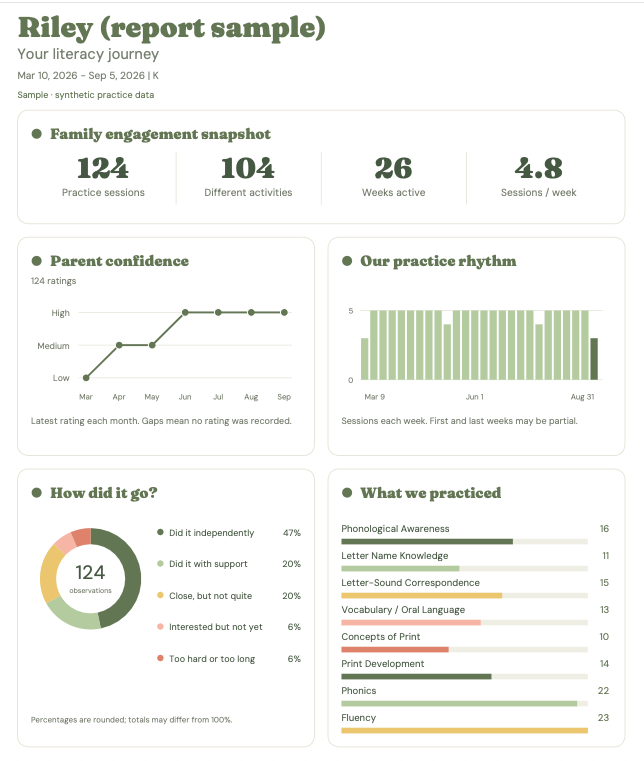
Parents get specific activities aligned to their child's current IRP goals. Teachers see home engagement data. The 6× research effectiveness transfers from theory to practice through daily coaching.

Multiplication

The home becomes a force multiplier for classroom instruction. Progress monitoring happens continuously, not just at benchmark windows. Moving from 50.3% to 80% proficiency becomes mathematically achievable when the home multiplier activates.

What a parent actually experiences

No training required. No jargon. No family literacy night a rural parent has to drive to. No device time for the child. Just the home multiplier, activated.

  1. 1

    Parent opens the app

    Simple questions about their child's age, what they've noticed, what they want to work on. Connected to their child's IRP if the district participates.

  2. 2

    rinnalla generates a coaching session

    Brief explanation of one foundational skill — phonological awareness, phonics, vocabulary — in plain language. Why it matters for reading. How it multiplies classroom instruction.

  3. 3

    A specific activity, right now

    Something they can do in the next ten minutes. Language they can use so it feels like play, not school. Materials they already have. The 6× effectiveness, activated.

  4. 4

    Progress your district can see

    Home multiplier engagement data aligned to IRP goals — evidence that the parent is executing their role in the literacy team.

The five Science of Reading pillars

Phonological Awareness

Hearing and manipulating the sounds in spoken words.

Phonics

Connecting letters and sounds to decode written words.

Fluency

Reading with accuracy, pace, and expression.

Vocabulary

Knowing what words mean and how they're used.

Comprehension

Building meaning from text in real time.

SB 241 · Effective July 1, 2026

Your home multiplier needs to be operational when school starts in August. Let's build it together.

We'll be at the UAESP Summer Conference (June 9–10), the UAPCS Summer Conference (June 10–11), and the Utah Rural Schools Conference (July 15–17). District meetings work too. ISTE 2026 if you're attending. A 20-minute conversation about your IRP implementation timeline is worth more than a procurement process that starts in September.